The shortlist
We compared published specifications and care instructions with the job each item needs to do. These are research-based assessments, not hands-on test results. Each pick links to its source; sellers show current prices and availability.
01 · Receive weather alerts and broadcasts
Midland ER310
NOAA weather reception plus several power options make it useful when ordinary information channels are disrupted.
The tradeoff: Receives information; it cannot transmit a request for help. Reception and battery readiness must be checked.
Read the maker’s specifications ↗02 · Nearby household or group check-ins
Midland T61VP3 FRS pair
Two compatible handhelds offer a straightforward starting point without an individual U.S. FRS license.
The tradeoff: Buildings and terrain shorten range. Test your route; the advertised maximum is not an urban coverage promise.
Read the maker’s specifications ↗03 · A licensed group with a practiced communication plan
Midland GXT67 PRO GMRS
A 5-watt, IP67-rated handheld with repeater capability for a more deliberate GMRS setup.
The tradeoff: U.S. GMRS licensing applies. A usable repeater needs local coverage, permission where required, and working backup power.
Read the maker’s specifications ↗04 · Road travel or an existing local CB group
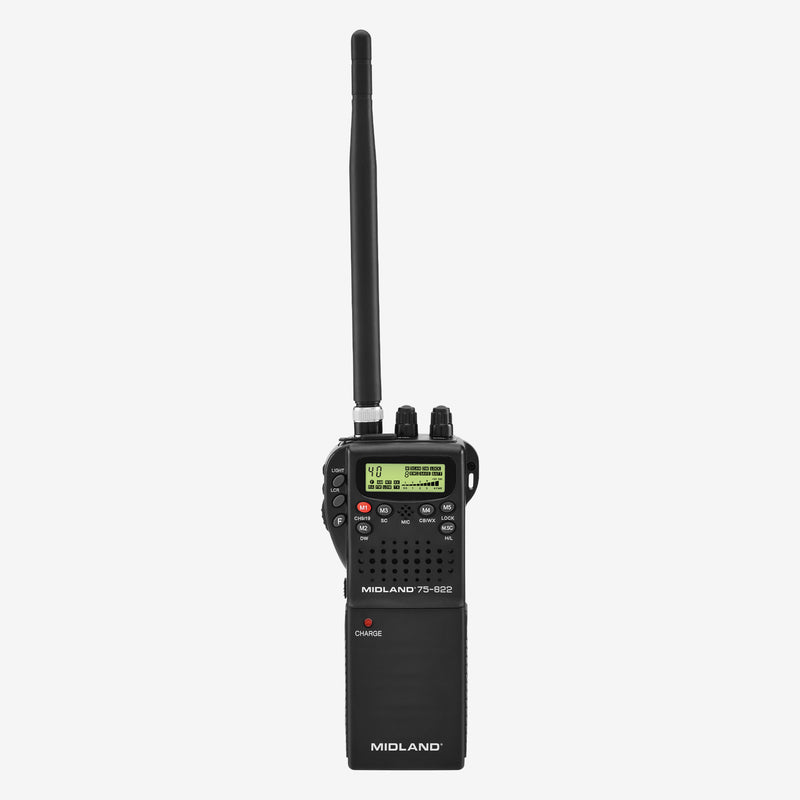
Midland 75-822 CB
A portable/mobile 40-channel CB with 4-watt output and NOAA weather reception.
The tradeoff: Antenna installation and local listeners matter. CB channel 9 is not a guaranteed emergency dispatch service.
Read the maker’s specifications ↗How this guide was made
This is a research-based comparison of manufacturer specifications, supplier availability, and current U.S. radio rules, checked September 23, 2026. We have not conducted a side-by-side range or battery-life test. The recommendations concern fit for a job, not a laboratory ranking.
A weather radio is a listener
The ER310 is the useful first distinction: it receives broadcasts and weather information but does not let you talk back. Its hand crank and solar input provide additional charging options; they should not be treated as a promise of effortless, unlimited power. Charge it, follow the manual, find a receivable station, and rehearse the controls in daylight.
A weather receiver is one part of an information plan. Keep local alert arrangements and written contact details too. A building’s position, terrain, and transmitter coverage can affect what you receive.
FRS is the simple conversation to start with
Certified Family Radio Service handhelds are useful for short-distance conversations between people who have agreed to listen. The T61VP3 pair gives a household two matching radios. Choose the same channel and compatible tone settings, and test from the places you actually intend to use them.
In the United States, FRS does not require an individual license when operated under the applicable rules. It is a different service from CB. Some FRS and GMRS channels are shared, but that does not make every GMRS radio license-free. Read the equipment’s certification and instructions, not just the channel number.
GMRS adds capability and responsibility
The GXT67 PRO offers 5-watt output, an IP67 rating, and repeater capability. That can be useful for a licensed household or group willing to learn the equipment. It does not make trees, concrete, distance, or a valley disappear.
U.S. GMRS generally requires an individual FCC license. The rules allow specified immediate family members to operate under that license; do not assume it covers a whole neighborhood. Check the current FCC requirements before ordinary operation. Repeater access is a separate practical question: is there one in range, may you use it, and will it remain powered during an outage?
CB makes sense when there are CB users to reach
The 75-822 is a genuine CB option, with 40 channels, 4-watt output, a removable antenna, and vehicle-use capability. Consider it for a road-travel setup or an established local CB group. Confirm the correct vehicle antenna and installation before expecting mobile performance; a short handheld antenna is a compromise.
CB operation in the United States does not require an individual license when compliant with the service rules. Channel 9 is reserved for emergencies and traveler assistance. That reservation does not guarantee anyone is monitoring it, and a CB cannot talk to an FRS or GMRS radio just because both displays say “9.” Channel numbers are labels within different services.
Test the boring parts
Before buying extra radios, borrow or test compatible equipment where possible. A useful test ends with notes about where the connection failed. Nobody needs a victory speech because two people standing in the driveway could hear each other.
- Choose the people, compatible service, channel, and check-in times. Write them down.
- Test from normal indoor locations and the actual route, without entering unsafe places to chase a signal.
- Practice a short message: who you are, where you are, what you need, and when you will listen again.
- Check charging, spare-power compatibility, volume, lock controls, and the maker’s storage instructions.
- Keep a fallback meeting place and emergency-service contact plan. Radio failure should not erase the whole plan.
Buy the missing capability
If nobody in your household can receive official weather information without a phone, begin there. If you need to coordinate across a nearby property or with family down the block, test an FRS pair. Spend more on GMRS or CB when there is a specific group and a realistic use for it.
The useful kit is the one your household understands. Put the radio beside water, a headlamp, and a written plan—not in a drawer marked “we should learn this someday.”