Why this is a September story, not a recycled outrage
The July reduction of Bears Ears National Monument is now a dispute about what happens on the ground and who gets a meaningful role in managing it. On September 2, Patagonia announced its renewed legal challenge. On September 24, the Bears Ears Inter-Tribal Coalition published an update connecting the rollback to Tribal governance, mineral claims, and newly released Utah polling.
Our view is that keeping a landscape publicly owned is only one part of protecting it. The uses allowed there, the institutions charged with caring for it, and the people involved in those decisions matter too. A headline that says everything has been sold can be wrong. A reply that says everything is fine because the land is still federal can also miss the consequential change.
What the proclamation changes—and what it does not prove
The July 13 proclamation redraws Bears Ears around approximately 121,096 acres, compared with about 1.36 million acres under the 2021 boundaries. Its stated rationale is that the earlier designation exceeded what the Antiquities Act permits and that other protections are sufficient. That is the administration’s legal and policy position, which the challengers dispute.
The text opens excluded lands to specified public-land and mineral laws after 60 days, subject to existing rights, withdrawals, and applicable law. It also terminates the Bears Ears Commission. It does not itself document a completed sale of every excluded parcel or approve a particular operating mine. A boundary, a mining claim, a lease, and a project authorization are different entries in the paper trail.
For someone who camps, climbs, hunts, or gathers knowledge here, that distinction has a practical consequence: do not infer today’s access rules from yesterday’s headline. Check the managing agency’s current map and site-specific rules. A smaller monument is not a universal permission slip for either development or recreation.
Where the lawsuit actually stands in the sources
NRDC’s case page, last updated September 2 and checked for this edition on September 27, describes a motion to reopen the existing Bears Ears case and a proposed amended and supplemental complaint. It labels that motion pending. The linked filing is Document 269-2 in case 1:17-cv-02590-TSC, filed September 2, 2026. That is more precise than treating the announcement as a court victory.
The proposed complaint asks the court to invalidate the 2017 and 2026 reductions and prevent agencies from implementing them, among other remedies. Those are requests by plaintiffs, not findings by a judge. This edition does not establish a later court order from a live docket, so it makes no claim that the reduction has been halted or upheld.
The central disagreement is about presidential authority to undo protections created under the Antiquities Act. Patagonia can bring public attention and resources; a clothing company’s press release cannot settle that question. To follow the case, look for the next order and read what it actually directs, including its geographic reach and effective date.
The people in the landscape are not supporting characters
The Bears Ears coalition brings together the Hopi Tribe, Navajo Nation, Ute Indian Tribe, Ute Mountain Ute Tribe, and Zuni Tribe. Its July response emphasizes continuing relationships with ancestral homelands and a commitment to collaborative management. Those are the positions of sovereign Tribal nations, not simply an outdoor user group with a different preferred trailhead.
The coalition’s September update describes people returning to pray, gather medicines and foods, visit important places, and teach younger generations. That gives the governance argument a concrete meaning. Decisions about roads, extraction, visitor use, and cultural-site protection affect practices that continue in the present; they are not merely questions about preserving an attractive view of the past.
Our conclusion is that a serious public-land story must examine who has an actual role in decisions. Saying that consultation remains possible does not answer whether the earlier collaborative institution survives, what authority replaces it, or how disagreements will be resolved.
The new poll is useful evidence, with a defined boundary
The coalition reports that 66 percent of respondents supported restoring greater protections to Bears Ears and Grand Staircase-Escalante, and 82 percent supported a strong Tribal role in managing public lands with sacred or culturally significant places. New Bridge Strategy interviewed 500 registered Utah voters on August 10–17 by telephone and online; its memo gives an overall margin of error of ±4.38 percentage points. Respondents first received descriptions of the reduced protections and Tribal management context, so these are responses to framed questions, not unprompted opinions.
These are reported results from a particular survey, not a national vote or proof that every respondent agrees on a management plan. The coalition advocates for protection, and its page links the poll materials for inspection. What the result usefully challenges is the assumption that the only local interest is reducing protections. It does not remove the need to read the questions, identify who was surveyed, and understand the proposal itself.
Another live decision: the Roadless Rule deadline is October 6
The separate Forest Service proposal to rescind the 2001 Roadless Rule is also part of this news cycle. The original September 21 comment deadline has been extended to October 6, 2026, according to the September 11 Federal Register notice. The rulemaking is identified as FS-2025-0001 and RIN 0596-AD66. As of this September 27 update, that published deadline is still ahead.
This is a proposed rule, distinct from the Bears Ears proclamation and litigation. The extension covers comments on the proposal, draft environmental impact statement, and cost-benefit analysis. For readers who want to participate, read the relevant section and explain a specific consequence for a watershed, place, or use. A concrete observation gives the agency something to evaluate; a forwarded slogan mostly gives it another copy.
Check the live docket before submitting, especially if reading this after October 6. The notice says comments become part of the public record. A deadline is not evergreen advice, and publishing an old closing date as current would send readers to the wrong next step.
Visit as though the place matters after you leave
A trip can deepen understanding, but it is not a substitute for respecting the people and places being discussed. The coalition’s Visit With Respect guidance explains how to approach cultural sites and sensitive ground. Read it before turning a legal dispute into an itinerary.
Then keep following the unglamorous parts: agency notices, management decisions, court orders, and the Tribal coalition’s own accounts. A land sale, a new mining claim, a permitted project, and a changed management body deserve separate reporting. Protecting open country becomes harder when every development is flattened into the same alarming sentence. It becomes harder still when the story ends with a scenic photograph and no explanation of what changed.
Reporting and photograph note
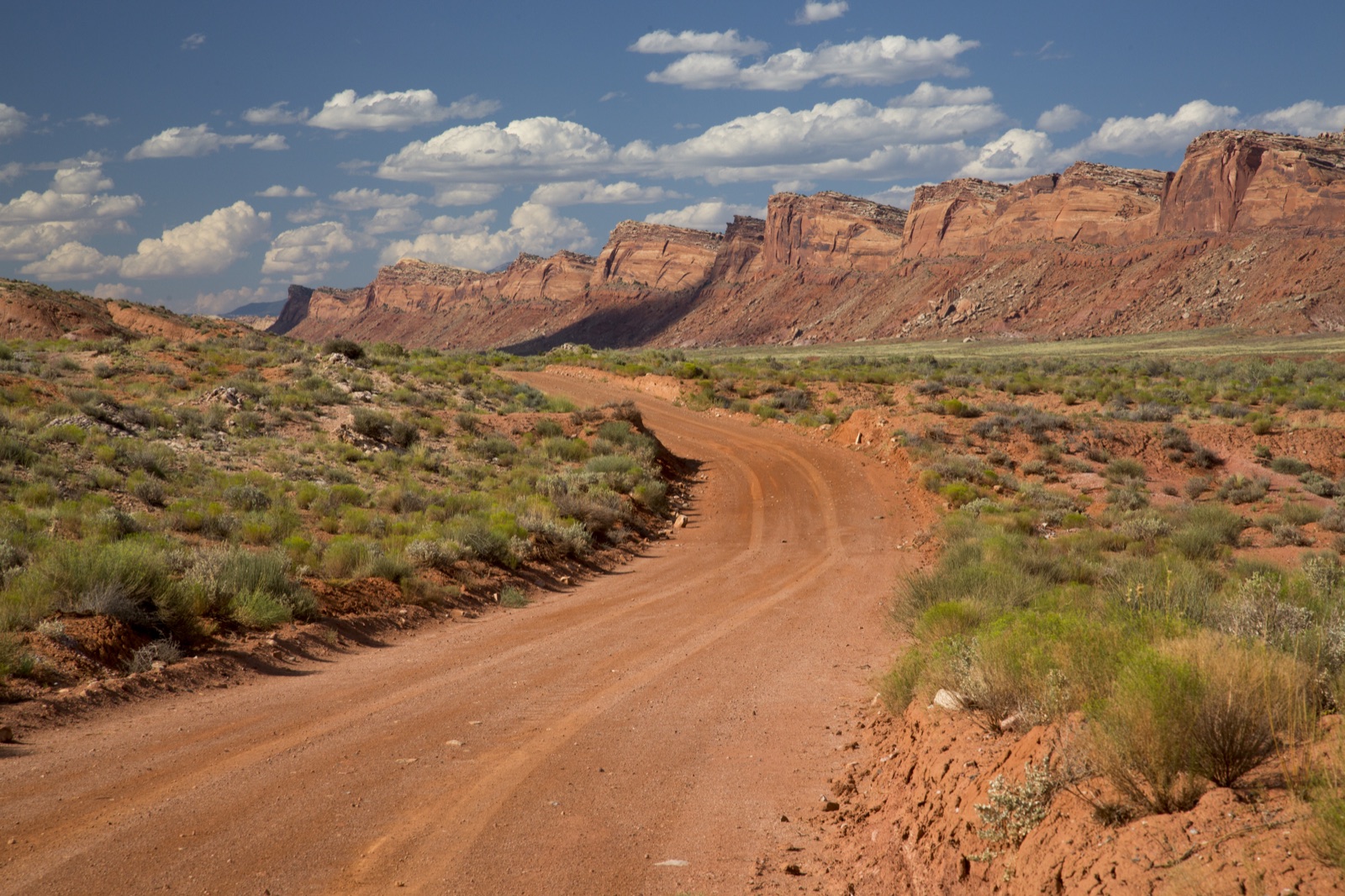
Updated September 27, 2026. This edition distinguishes official actions, a proposed rule, litigants’ requests, reported polling, and our own analysis. Court-status reporting is limited to the dated documents linked above. The photograph shows Lower Comb Wash Road in the Bears Ears landscape; it is not a map of the revised boundary or evidence of new development.


.jpg)